The Or Foundation’s community-led response to fashion waste in Ghana
- Regenerative Agriculture
- Circular Fibersheds
- Recycle & Reuse
- Nature Conservation
- Ecosystem Restoration
- Wetland Restoration
- Science & Technology
- Climate Heroes
- Afrotropics Realm
- Equatorial Afrotropics

Each week, One Earth is proud to feature a Climate Hero from around the globe who is working to create a world where humanity and nature can thrive together.
When fast fashion becomes someone else’s burden
In the heat of Accra, Ghana, Kantamanto Market gives millions of used garments a second life. It is one of the world’s largest secondhand clothing hubs, sustained by traders, tailors, upcyclers, and market workers who keep clothing moving through a global system built on constant turnover. But behind that circulation is another kind of labor, quieter and far less celebrated: the work of communities managing the waste the fashion industry leaves behind.
Near the market, along the sacred Korle Lagoon and its surrounding wetlands, discarded textiles pile up disturbing the natural ecosystem An estimated 147,000 tons of textiles arrived in Ghana in 2023 alone, with the majority passing through Kantamanto. Roughly 15 million garments move through the market each week, and about 40% go unsold and are considered waste. What is left behind ends up discarded near the wetlands, turning what the Indigenous Ga people know as Naa Korle, a sacred landscape, into one of the most visible endpoints of the global clothing trade.
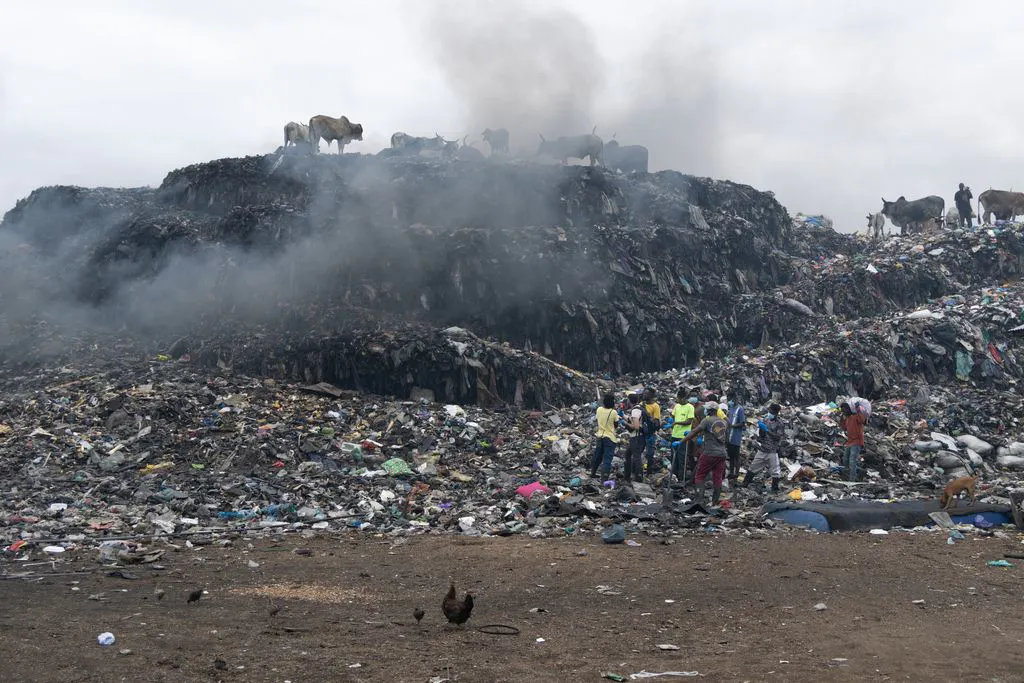
The Or Foundation sampling team prepare to take sediment samples from an informal dumpsite. Image courtesy of The Or Foundation.
A pilot rooted in community
For more than a decade, The Or Foundation has worked within and around Kantamanto at the intersection of research, advocacy , and direct action. The organization describes its work as advancing a justice-led circular textiles economy grounded in community ecological care.
That grounding is what makes this pilot project feel different. Rather than starting with a new waste technology, the work begins with a different question: what can be learned by listening to the ecosystem and the people already living with the crisis? The case study describes this as a radically different approach to circularity, one that prioritizes restoration over control and collaboration with nature’s own adaptive processes.
“Korle Lagoon teaches us that innovation, pragmatism and justice are inseparable when we align with the intelligence that has sustained life on Earth for billions of years.” — Katia Osei, Head of Environmental Justice, The Or Foundation.
That approach is visible throughout the pilot. Around Korle Lagoon, local knowledge is not treated as secondary to scientific research, but as part of its foundation. The team includes artists, community members, and field researchers whose understanding of Korle comes from living with and observing the lagoon.
Citizen science research rooted in the Agbogbloshie wetlands and Accra’s coastline combines field observation, environmental sampling, and ecological monitoring guided by people who know Korle intimately. Here, community-led means research, stewardship, and restoration built from the inside out.
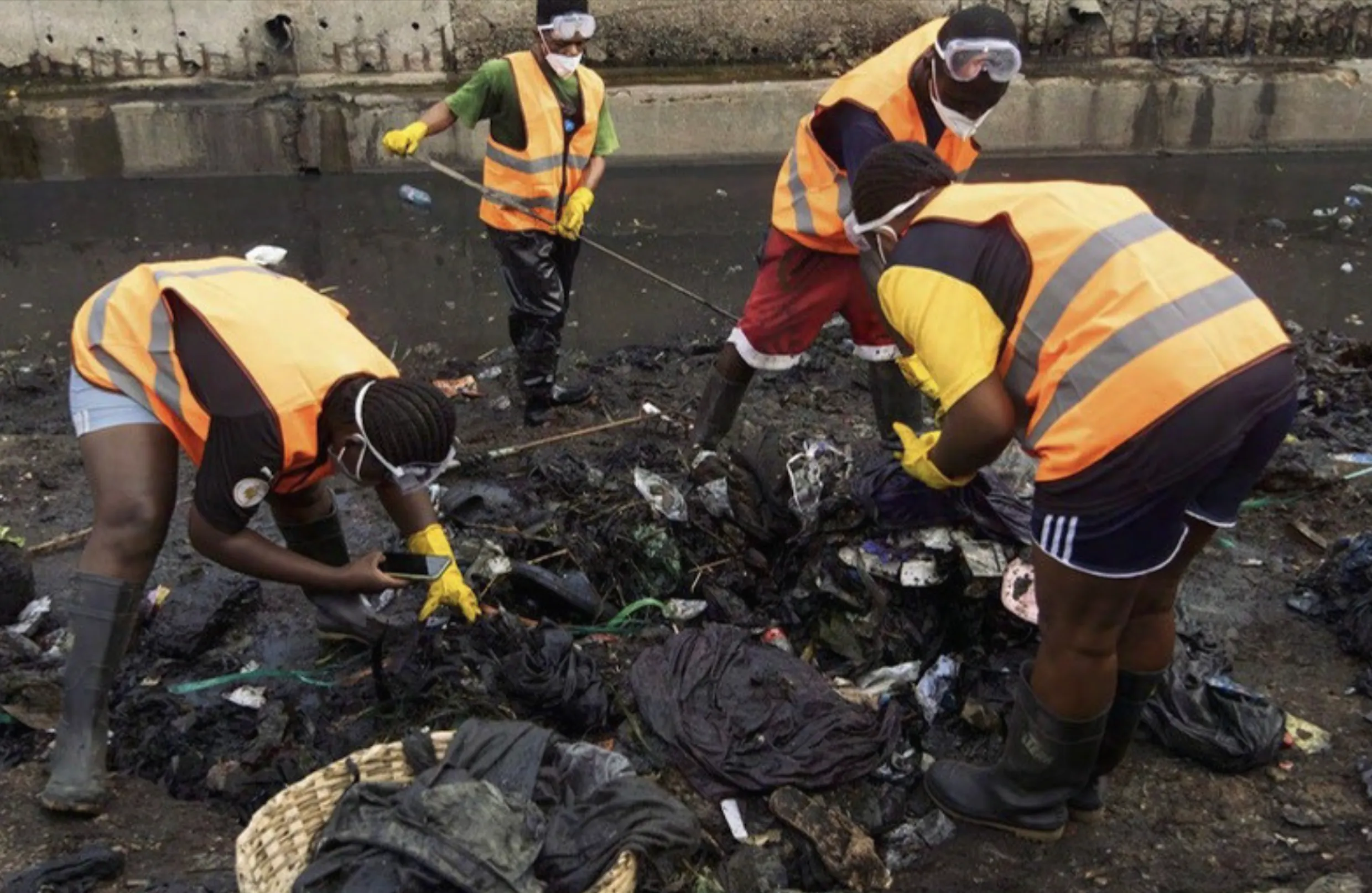
June Four Task Force members audit textile waste found in the canal. Image courtesy of The Or Foundation.
Where the textile industry’s hidden costs become visible
For many people in the Global North, clothing waste is made invisible by design. Garments are donated, exported, and moved elsewhere, creating the illusion that the problem has been handled. Hidden from the places where it is created, waste becomes someone else’s burden. In the Global South, the consequences of overproduction are highly visible, with communities living among the fallout.
Korle Lagoon is one of those places where the hidden becomes impossible to ignore. The case study describes it as one of West Africa’s most polluted water bodies, where textiles pile up on the banks, float in the water, sink into sediment, and fragment into microfibers. As The Or Foundation puts it plainly, the waste crisis is not due to a lack of technology. It is due to overproduction.
Wetlands, the “kidneys of the planet”
If forests are often described as the lungs of the planet, wetlands do the quieter work of kidneys. They filter, process, and hold what other systems push downstream. Around Korle Lagoon, those functions have been strained by years of accumulated textile waste, chemical runoff, and the pressure of a global industry that treats certain places as endpoints.
That is part of what makes restoration here so important. Restoring Korle means more than clearing waste. It means supporting the ecological functions that allow wetlands to filter toxicity, buffer harm, and create the conditions for renewal. In this story, the wetlands are not just the backdrop. They reveal both what this system has damaged and what restoration still makes possible.
Learning from a living lab
The Ghana pilot treats Korle Lagoon as a Living Lab. Its core hypothesis is that in places where textile pollution is most concentrated, microbial communities may be adapting to metabolize synthetic polymers, creating natural forms of bioremediation. Beneath the visible crisis, life is already responding.
That research is rigorous, but the point is bigger than the science alone. The Or Foundation’s team has carried out microcosm experiments, developed field-deployable genetic analysis tools, and studied decomposition across the lagoon’s terrain. Yet the case study argues that supporting the adaptive processes already at work in Korle may be more effective, more scalable, and more just than trying to override them with imported solutions.
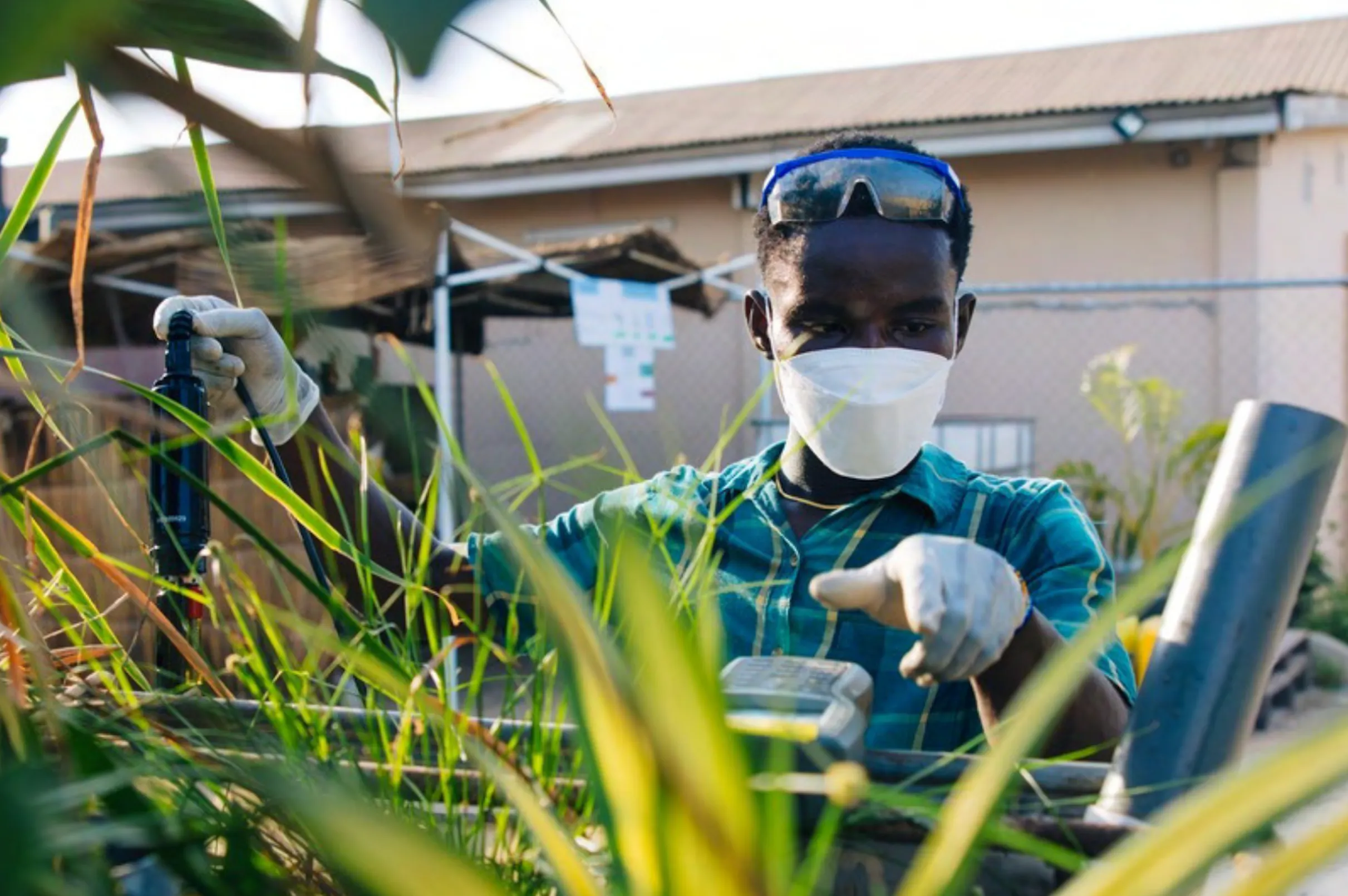
The Or Foundation team tracks indicators of ecosystem health, such as dissolved oxygen in water. Image courtesy of The Or Foundation.
The third chapter in Nature of Fashion
This article is the third in One Earth’s series on the Biomimicry Institute’s Nature of Fashion: Design for Transformation initiative, following earlier features on pilots in the Netherlands and Germany. Those first two stories explored what happens when difficult textile waste is treated not as an endpoint, but as material that can be transformed into new inputs and products.
Ghana expands that story in a crucial way. While the European pilots focused more directly on transforming textile waste into new material streams, The Or Foundation begins where fashion’s burden is already being felt most directly, asking how restoration can start in a landscape under pressure.
Restoration requires accountability
The broader Nature of Fashion narrative is careful not to present decomposition as a cure-all. It says clearly that decomposition is necessary, but not sufficient. Real change also requires reducing waste at the source, confronting planetary boundaries, and holding industry accountable for the quality and quantity of what it produces.
That is why the Ghana pilot feels so urgent. It shows what community-led ecological care looks like at a site carrying the burden of global overproduction, but it also makes clear that communities like those around Korle should never have been asked to absorb this much harm in the first place. The Or Foundation’s work reminds us that restoration begins with local stewardship, community-led science, and a more honest understanding of where fashion ends up when the world is done with it.
Contact: [email protected]

Subscribe to receive monthly updates on climate solutions, environmental heroes, and the profound beauty and wonder of our shared planet Earth.
.jpeg?auto=compress%2Cformat&h=600&w=600)