Meet the toadhead agama: The desert lizard with a dramatic defense display
- Nature Conservation
- Land Conservation
- Iconic Species
- Wildlife
- Reptiles
- Caspian Sea & Central Asian Deserts
- Central Eurasia Realm

One Earth’s “Species of the Week” series highlights iconic species that represent the unique biogeography of each of the 185 bioregions of the Earth.
In the shifting sands of Central Asia and the Middle East, a small lizard holds a surprisingly theatrical secret. At first glance, the toadhead agama blends almost perfectly into its surroundings, its sandy body nearly indistinguishable from the dunes it inhabits. But when threatened, it transforms in an instant, unfurling bright flaps of skin and hissing with intensity, a display that can startle even the most determined predator.
Known scientifically as Phrynocephalus mystaceus, the toadhead agama is one of the most striking members of its genus, both for its appearance and its behavior. Yet, despite its range across several countries, much of its life remains only partially understood.
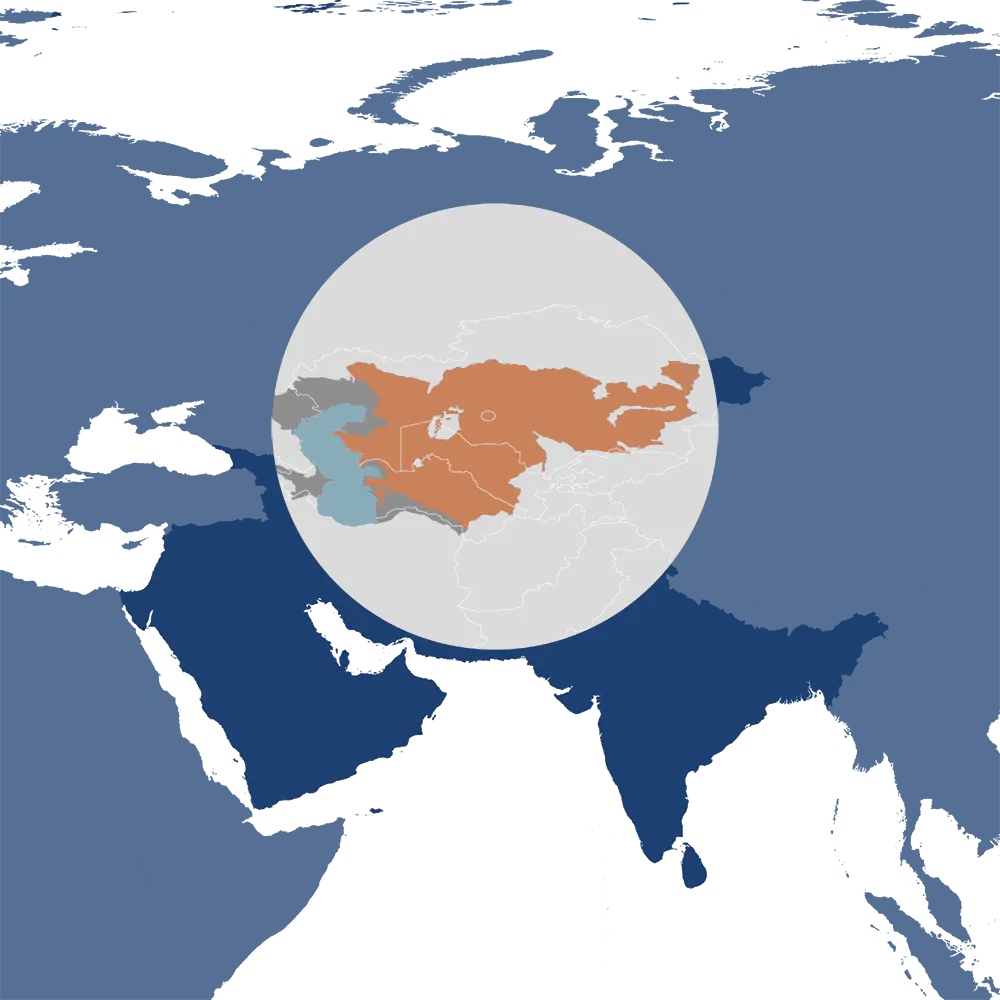
In the One Earth Bioregions Framework, the toadhead agama is the iconic species of the Central Asian Deserts & Riparian Woodlands bioregion (PA32), located in the Caspian Sea & Central Asian Deserts subrealm of Central Eurasia.
Life in shifting desert sands
The toadhead agama inhabits arid regions stretching from southern Russia and Kazakhstan to northwestern China, as well as northern Iran, Afghanistan, Turkmenistan, Tajikistan, Kyrgyzstan, and Uzbekistan. Within these regions, it favors sandy deserts, especially barchan dunes dotted with sparse shrubs and low vegetation.
During the warmer months, these lizards are often found on open sands, sometimes even near human-made environments such as roadsides. As temperatures drop, they retreat underground. From November to February, they overwinter in burrows they dig into dune slopes, tunnels that reach 80 to 100 centimeters (31 to 39 inches) in length and end in a moist chamber where temperatures remain around 5 to 12°C (41 to 54°F).
A sandy disguise with a hidden flash of color
Adult toadhead agamas are medium-sized lizards, reaching up to 24 centimeters (9.4 inches) in total length, including their tail. Their coloration is well suited to desert life, with sandy tones, light gray spots, and a milky-white underside that helps them blend into their environment.
Several features make them unmistakable. They have a flattened snout and large skin lappets at the corners of their mouths, which can be spread dramatically when the animal feels threatened. Their tails end in black, and a dark patch often marks the throat, especially in males. Juveniles differ slightly, with lighter throats and orange coloring on the underside of their hind feet and tail.
Their toes are equipped with fine comb-like structures that aid in digging and moving across loose sand, an adaptation essential for both escape and shelter.
A diet built on desert insects
Toadhead agamas are active hunters during the warmer months, feeding primarily on insects and other small invertebrates. Their diet includes beetles, locusts, ants, flies, and spiders.
They spend much of their day foraging, with activity peaking in the morning and evening when temperatures are more moderate. This pattern helps them avoid the most extreme heat of the desert while maximizing their chances of encountering prey.
A small predator with an ecological role
As insectivores, toadhead agamas play a role in regulating populations of insects and other arthropods in their ecosystem. In environments where life can be sparse and conditions harsh, even small predators contribute to maintaining balance.
Their burrowing behavior also influences the desert landscape, creating shelters that may later be used by younger individuals or other small organisms.
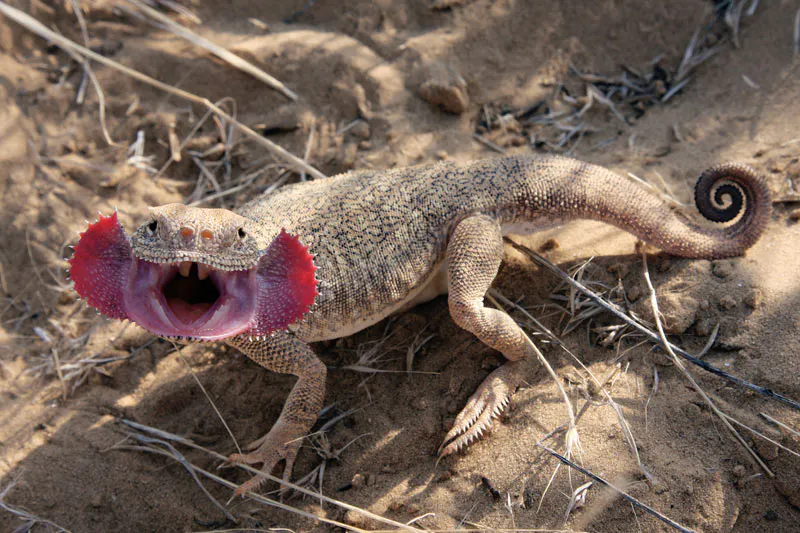
The toadhead agama's striking threat display. Image Credit: Antoshin Konstantin, Wiki Commons.
Dramatic defenses and territorial lives
Perhaps the most remarkable aspect of the toadhead agama is its defensive display. When threatened, it flattens its body, opens its mouth wide, and unfurls the brightly colored flaps at the corners of its jaws. This is accompanied by continuous hissing, creating a startling visual and auditory warning designed to deter predators.
Socially, these lizards are known for their aggressive interactions. Encounters between individuals of different ages and sexes often result in confrontations. Communication includes the display of their mouth lappets and tail movements, adding to their already expressive repertoire.
Despite these observations, much about their social structure and behavior remains understudied, leaving room for future research.
Seasonal rhythms and reproduction in the sand
The toadhead agama is oviparous, laying eggs rather than giving birth to live young. The mating season runs from late April to early July. Females typically produce two clutches per year, one in June and another in late July, burying their eggs in the sand.
Each clutch contains between 2 and 6 eggs, depending on the age of the female. Hatchlings emerge in July and August, measuring about 30 to 40 millimeters (1.2 to 1.6 inches) in total length. They resemble adults but retain some juvenile coloration.
Young agamas tend to remain near their hatching sites and establish their own territories only after reaching 1.5 to 2 years of age.
Least concern but not without questions
Currently, the toadhead agama is classified as Least Concern in terms of conservation status. This reflects its relatively wide distribution and the absence of clear evidence for rapid population decline.
Even so, researchers note that many aspects of its life remain unexplored. However, like many desert species, it may still be vulnerable to habitat changes that alter the delicate balance of arid ecosystems. Continued study is essential to better understand its ecology, behavior, and long-term resilience in an uncertain world.
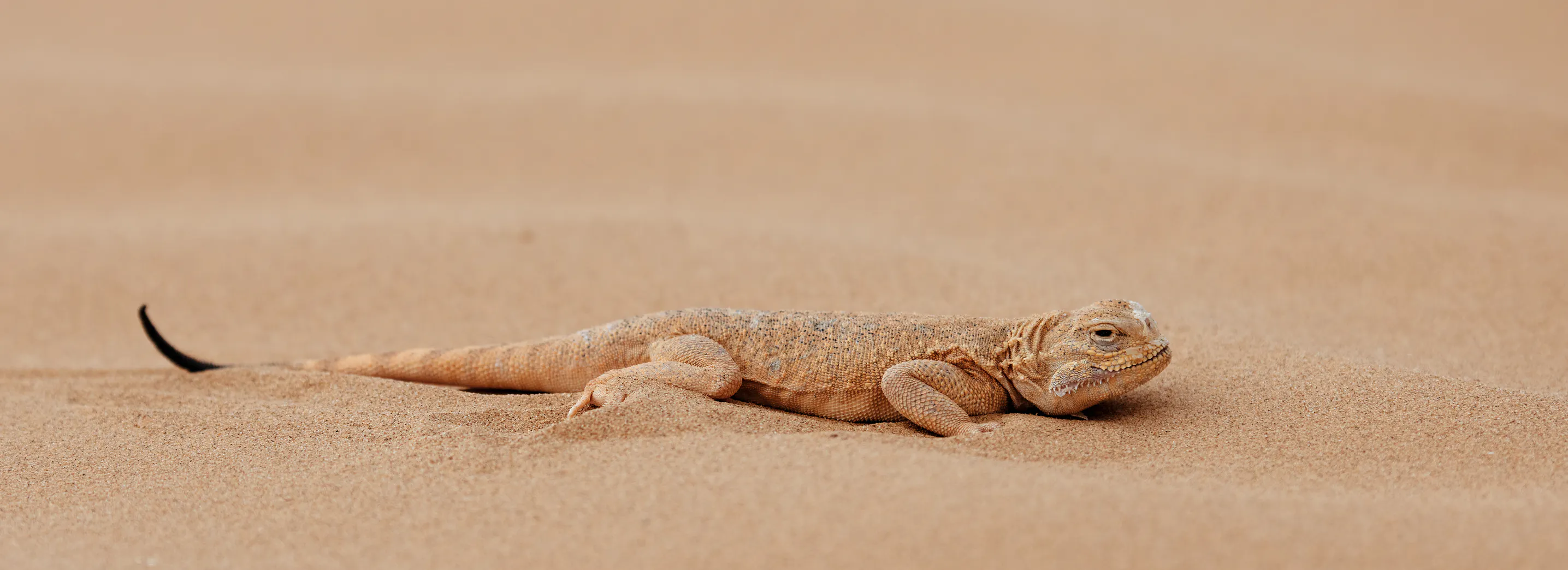
A toadhead agama blending into its desert sand environment. Image Credit: © Evgeniyqw, Dreamstime.
Understanding this lesser-known desert species
In a landscape defined by extremes, the toadhead agama survives through a combination of subtlety and spectacle. It can vanish into the sand in one moment and erupt into a vivid display the next. For a species that is still not fully understood, it offers a vivid reminder that even the smallest desert inhabitants can hold some of nature’s most surprising stories.

Subscribe to receive monthly updates on climate solutions, environmental heroes, and the profound beauty and wonder of our shared planet Earth.
What is an Iconic Species?
An iconic species is a charismatic and ecologically significant animal selected to represent the unique biogeographical diversity of each bioregion in One Earth's Bioregions Framework. Learn more >