The maned wolf: Long-legged icon of the South American grasslands
- Nature Conservation
- Land Conservation
- Iconic Species
- Wildlife
- Mammals
- Brazil Cerrado & Atlantic Coast
- Southern America Realm

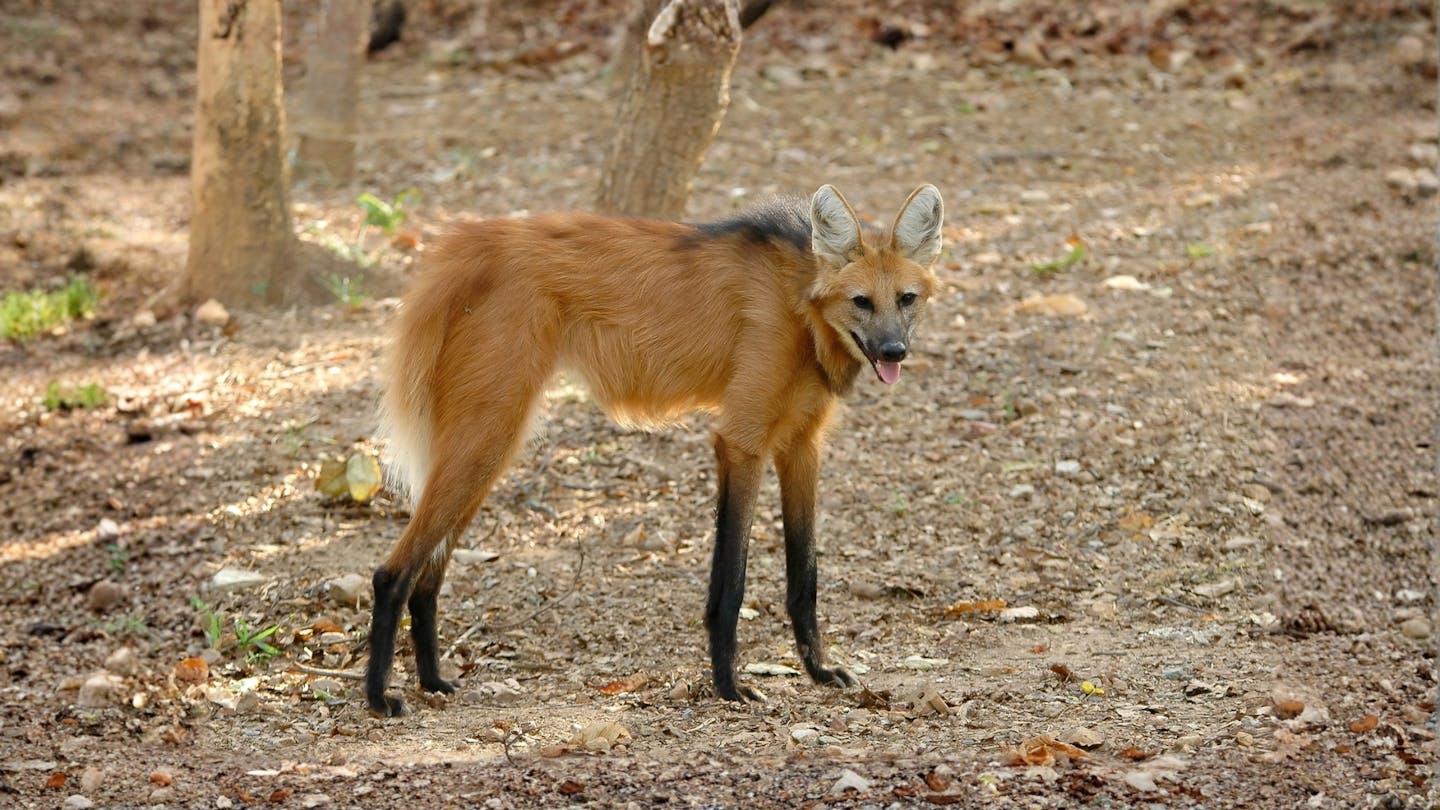
Rising above the grasses of South America’s savannas on noticeably long legs, the maned wolf (Chrysocyon brachyurus) looks like an animal assembled from a fairytale: part fox, part wolf, part deer. Its reddish coat glows in the last light of day, and its black mane can lift when the animal is alarmed, making an already striking silhouette seem even larger.
Yet, despite its name and appearance, the maned wolf is neither a true wolf nor a fox. It is something rarer: the sole living member of its genus Chrysocyon, a singular canid that has followed its own evolutionary path across the grasslands and scrub of the continent.

The maned wolf is the iconic species of the Cerrado Savannas bioregion (NT13), located in the Brazil Cerrado & Atlantic Coast subrealm of Southern America.
A life shaped by the open grasslands of South America
The maned wolf lives in open and semi-open grasslands with scattered bushes and trees. Its stronghold is the Cerrado, the vast savanna region of south, central-west, and southeastern Brazil, but its range also extends into Paraguay, northern Argentina, Bolivia east and north of the Andes, and far southeastern Peru. In Uruguay, it is now very rare and may have been almost completely displaced by habitat loss.
These landscapes help explain the animal’s form and behavior. The maned wolf forages in open fields, where it can move through tall grasses and listen for hidden prey, but it also uses more sheltered places, such as riparian forests, to rest, especially during warmer weather. It is well suited to a world of shifting edges, where scrub, prairie, and woodland meet.
Known for its long, slender legs
The maned wolf is the tallest wild canid. Adults can stand up to 110 centimeters (43 inches) at the shoulder, with a head-body length of about 100 centimeters (39 inches) and a tail measuring roughly 45 centimeters (18 inches). They typically weigh 20 to 30 kilograms (44 to 66 pounds), with an average adult weighing about 23 kilograms (51 pounds).
The coat ranges from reddish-brown to golden orange along the sides, set off by long black legs, a black mane along the nape, a white patch beneath the throat, and a whitish tuft at the tip of the tail. Its ears are especially long, about 18 centimeters (7.1 inches), helping it detect prey moving through dense grass.
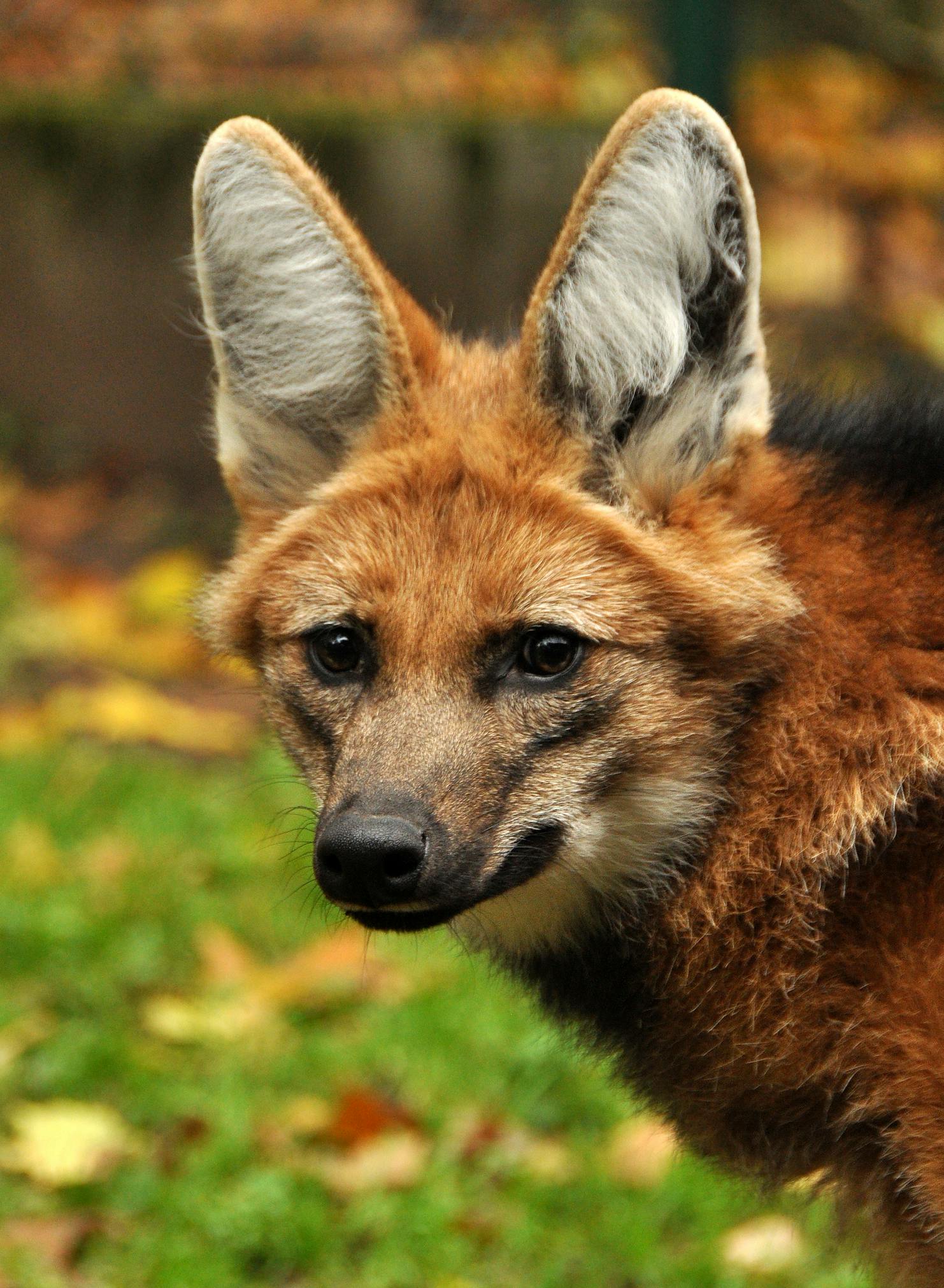
Close up of a maned wolf, showcasing their large ears. Image Credit: © Zanna Peshnina, Dreamstime.
An omnivore that hunts, digs, and feasts on fruit
The maned wolf is omnivorous, and its diet is remarkably broad. It feeds on small and medium-sized animals including rodents, rabbits, birds and their eggs, reptiles, fish, insects, gastropods, other terrestrial molluscs, and armadillos. Yet, a large share of its diet is plant matter, including fruit, sugarcane, tubers, bulbs, and other roots.
Among all these foods, one stands out: the wolf apple, a tomato-like fruit known scientifically as Solanum lycocarpum. This is the maned wolf’s most common food item and can make up 40 to 90 percent of its diet in some cases. Unlike many other fruits that are abundant only during the rainy season, wolf apple is eaten throughout the year. A maned wolf may consume several fruits at once and later disperse the seeds intact in its droppings.
When hunting, the animal relies on stealth and sound. It often rotates its large ears to locate prey in the grass, taps the ground with a front foot to flush an animal, then pounces. It may also dig holes or leap to catch birds in flight. Hunts are not always successful, but this adaptable feeding strategy helps the species persist across a wide range of conditions.
A seed disperser as important as a hunter
The maned wolf’s role in the ecosystem goes beyond predation. Because it consumes so much fruit and passes intact seeds through its digestive tract, it plays an important part in seed dispersal, especially for the wolf apple. In doing so, it helps shape the very plant communities through which it moves.
Its ecological influence extends further. Maned wolves often defecate near the nests of leafcutter ants. The ants use the dung to fertilize their fungus gardens but discard the seeds onto refuse piles outside the nest, where germination rates increase. This unexpected partnership makes the maned wolf not only a disperser of seeds, but also a participant in a broader web of ecological relationships.
Solitary, scent-marking, and most active at twilight
Unlike gray wolves or African wild dogs, maned wolves do not form packs. They are solitary animals, usually hunting and moving alone. They are primarily crepuscular, with peak activity often occurring between 8 and 10 AM and again between 8 and 10 PM though on cold or cloudy days they may remain active throughout the day.
Monogamous pairs may defend a shared territory of around 30 square kilometers (12 square miles), but outside the mating season the two animals may rarely meet. Their territories are marked with urine, which has such a distinctive odor that it has earned the species the nickname “skunk wolf.” The scent has been compared to hops or cannabis.
The maned wolf also communicates through sound, most notably with a loud vocalization known as roar-barking. Combined with scent marking, this helps individuals maintain space across the grasslands without needing the close social bonds seen in other large canids.
From black-furred pups to red-coated adults
The maned wolf’s mating season runs from November to April. Gestation lasts 60 to 65 days, and females usually give birth to two to six pups, though litters of seven have been recorded. Newborn pups are black-furred rather than red and weigh about 340 to 430 grams (12 to 15 ounces).
Their eyes open at around nine days of age. They nurse for up to four months, but by the third week their parents begin feeding them by regurgitation, a process that can continue for up to 10 months. At around three months old, pups start accompanying their mother while she forages. Both males and females engage in parental care, though females appear to do most of it.
By 10 weeks, the pups’ fur begins changing from black to red. They are fully grown at one year old and reach sexual maturity around that same time, when they leave their birth territory. Longevity in the wild remains unknown, but captive maned wolves have lived 12 to 15 years, with one zoo individual reported to have reached 22.
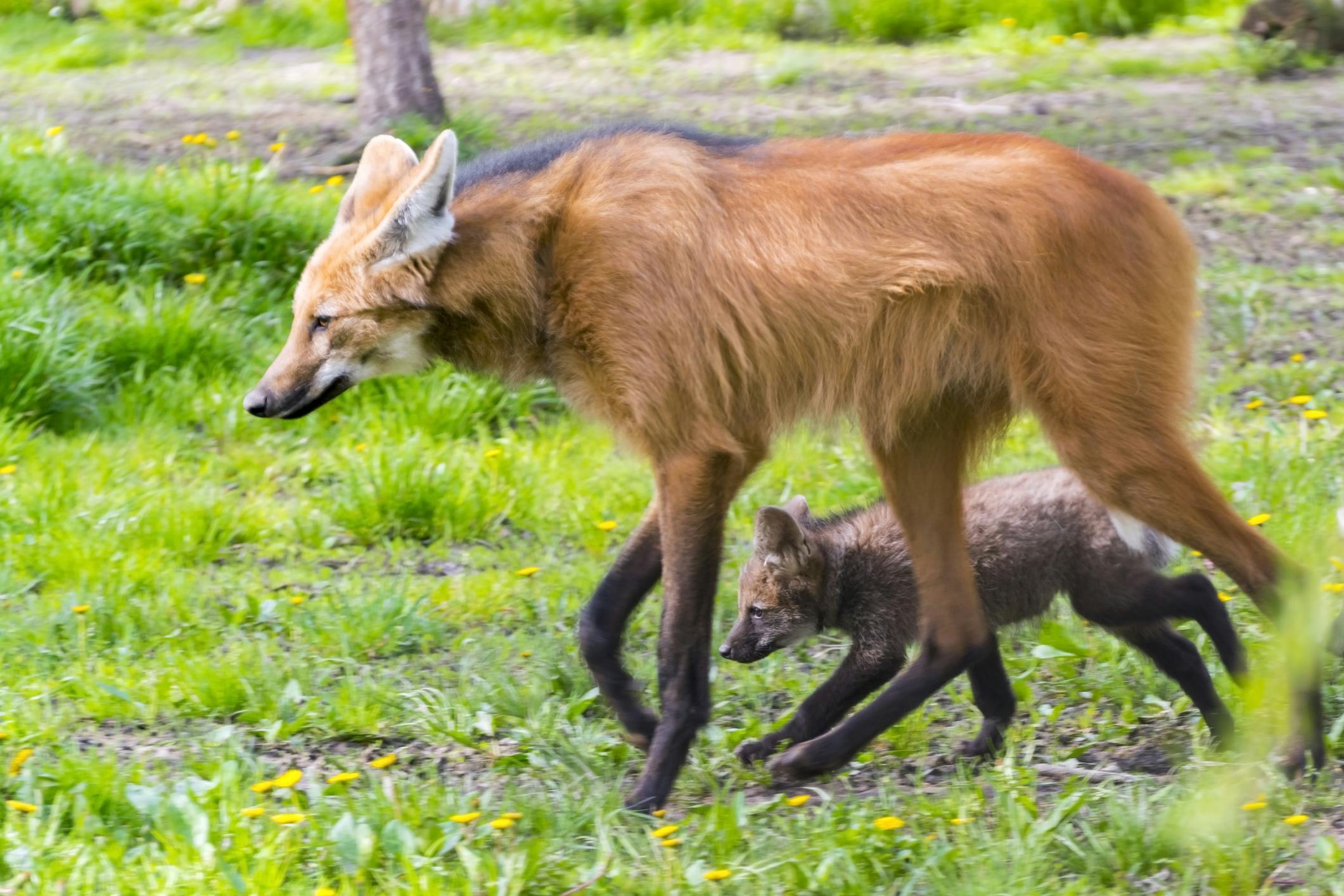
Maned wolf pup with mother. Image Credit: © Belizar, Dreamstime.
Cultural significance of the maned wolf
The maned wolf has long lived in the cultural imagination of the people who share its range. In the Guarani language it is known as aguara guasu, meaning “large fox,” and it was considered a common animal by the Guarani people. Early European names for the species often borrowed from Indigenous ones, and the Guarani name was used by some of the first naturalists who described it.
Attitudes toward the maned wolf vary across its range. In some regions, parts of the animal have been used for medicinal purposes or believed to bring good luck, while suspicion of it as a poultry thief likely reflects old European fears. Even so, it rarely provokes strong hostility and has become a symbol of Cerrado conservation in Brazil, where it appears on the 200-reais banknote.
Deforestation pushing the species into decline
Although the maned wolf has a wide range and can tolerate some disturbed habitats, its populations are declining. The main threats are tied to human activity: deforestation, urban growth, road traffic, and the steady loss and fragmentation of habitat. As natural spaces shrink, maned wolves may move closer to urban areas in search of food, increasing the chance of being struck by vehicles.
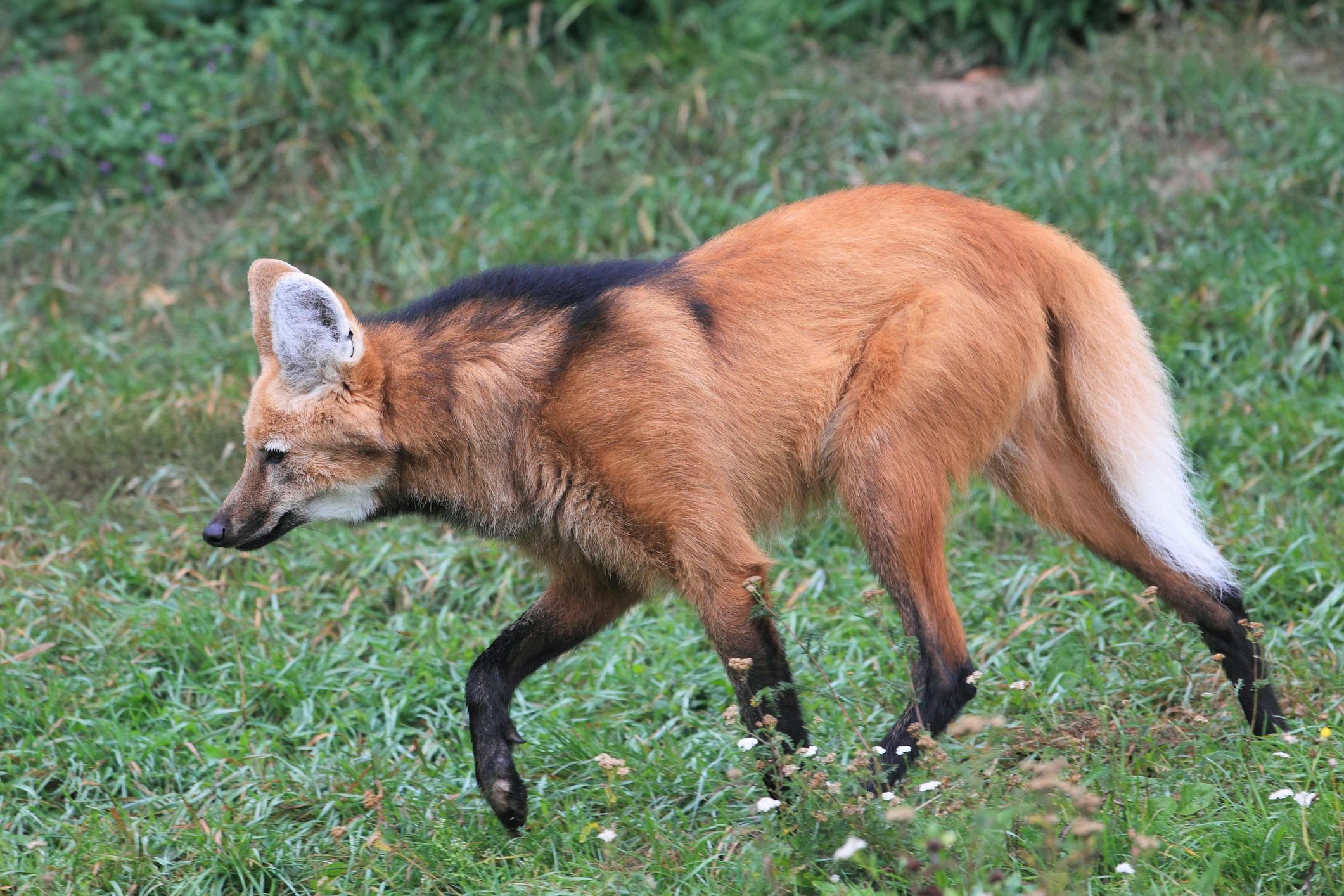
Maned wolf prowling the Cerrado. Image Credit: © Lukas Blazek, Dreamstime.
Conservation status and efforts
The International Union for Conservation of Nature lists the maned wolf as Near Threatened, reflecting its broad distribution but overall population decline. In Brazil, however, it is considered Vulnerable by the Brazilian Institute of Environment and Renewable Natural Resources, and some state-level lists classify it as endangered or critically endangered.
The species is protected against hunting in all countries where it occurs, and it lives in several protected areas, including Caraça and Emas national parks in Brazil.
Standing tall in a changing world
Tall as the grasses it moves through, the maned wolf remains one of South America’s most distinctive animals. It is a hunter, a fruit eater, a seed disperser, and a solitary presence in landscapes under growing strain.
To protect it is to protect more than a single species. It is to defend the open savannas, scrublands, and hidden ecological exchanges that allow a creature this unique to endure.
Explore similar content

Subscribe to receive monthly updates on climate solutions, environmental heroes, and the profound beauty and wonder of our shared planet Earth.
What is an Iconic Species?
One Earth’s Species of the Week series highlights charismatic and ecologically significant animals that represent the diversity of each of our 185 bioregions. These iconic species are part of the One Earth Bioregions Framework. Learn more >