.jpg?auto=compress%2Cformat&w=1440)
Geopolitical instability and the future of the Asiatic cheetah
- Nature Conservation
- Land Conservation
- Wildlife
- Mammals
- Persian Deserts & Forests
- Central Eurasia Realm

The fate of endangered species is often tied not only to ecology, but also to political stability. The Asiatic cheetah (Acinonyx jubatus venaticus) remains one of the world’s most critically endangered large carnivores, with only a few dozen individuals surviving in Iran. Its persistence depends on sustained, resource-intensive conservation efforts, making it highly vulnerable to disruptions caused by geopolitical instability.
While direct threats such as habitat loss, prey depletion, road mortality, and poaching continue to drive the species toward extinction, indirect pressures associated with political turmoil may prove equally devastating. Economic crises, sanctions, armed conflict, or broader instability can shift national priorities away from conservation, reduce environmental funding, weaken wildlife governance, and disrupt scientific collaboration. For a population this small, even short interruptions in protection and monitoring may have irreversible consequences.
.jpg)
Image credit: Courtesy of the Iranian Cheetah Society, DoE, SPOTS
History repeatedly demonstrates that war and political instability can accelerate wildlife collapse. During the Vietnam War, extensive deforestation and chemical warfare devastated ecosystems and contributed to severe biodiversity losses across Southeast Asia. In Africa, decades of armed conflict in countries such as Mozambique and the Democratic Republic of Congo led to catastrophic declines in elephants, antelope populations, and other large mammals due to uncontrolled poaching and the collapse of environmental enforcement.
Afghanistan’s prolonged instability also contributed to the disappearance of several regional wildlife populations and severely undermined conservation capacity. More recently, conflicts in the Middle East and parts of Eastern Europe have highlighted how quickly protected areas, ecological monitoring programs, and wildlife management systems can deteriorate during times of unrest.
.jpg)
Image credit: Courtesy of the Iranian Cheetah Society, DoE, SPOTS
Some species have vanished entirely under such conditions. The Arabian ostrich, once widespread across the Middle East, disappeared in the twentieth century following overhunting, habitat degradation, and regional instability. Similarly, the Caspian tiger became extinct after decades of habitat destruction and weakened environmental protections across Central and Western Asia. These examples illustrate how fragile wildlife populations can rapidly collapse when conservation systems are disrupted.
The Asiatic cheetah now faces a similar level of vulnerability. Frontline conservation efforts—including anti-poaching patrols, prey monitoring, habitat protection, and road mortality mitigation—depend heavily on the dedication of local rangers, researchers, and conservation practitioners working under difficult conditions. Iranian environmental organizations, including the Iranian Cheetah Society, have invested decades of expertise, persistence, and personal sacrifice into preventing the extinction of this subspecies. Any reduction in their operational capacity or international support increases the risk of population collapse.
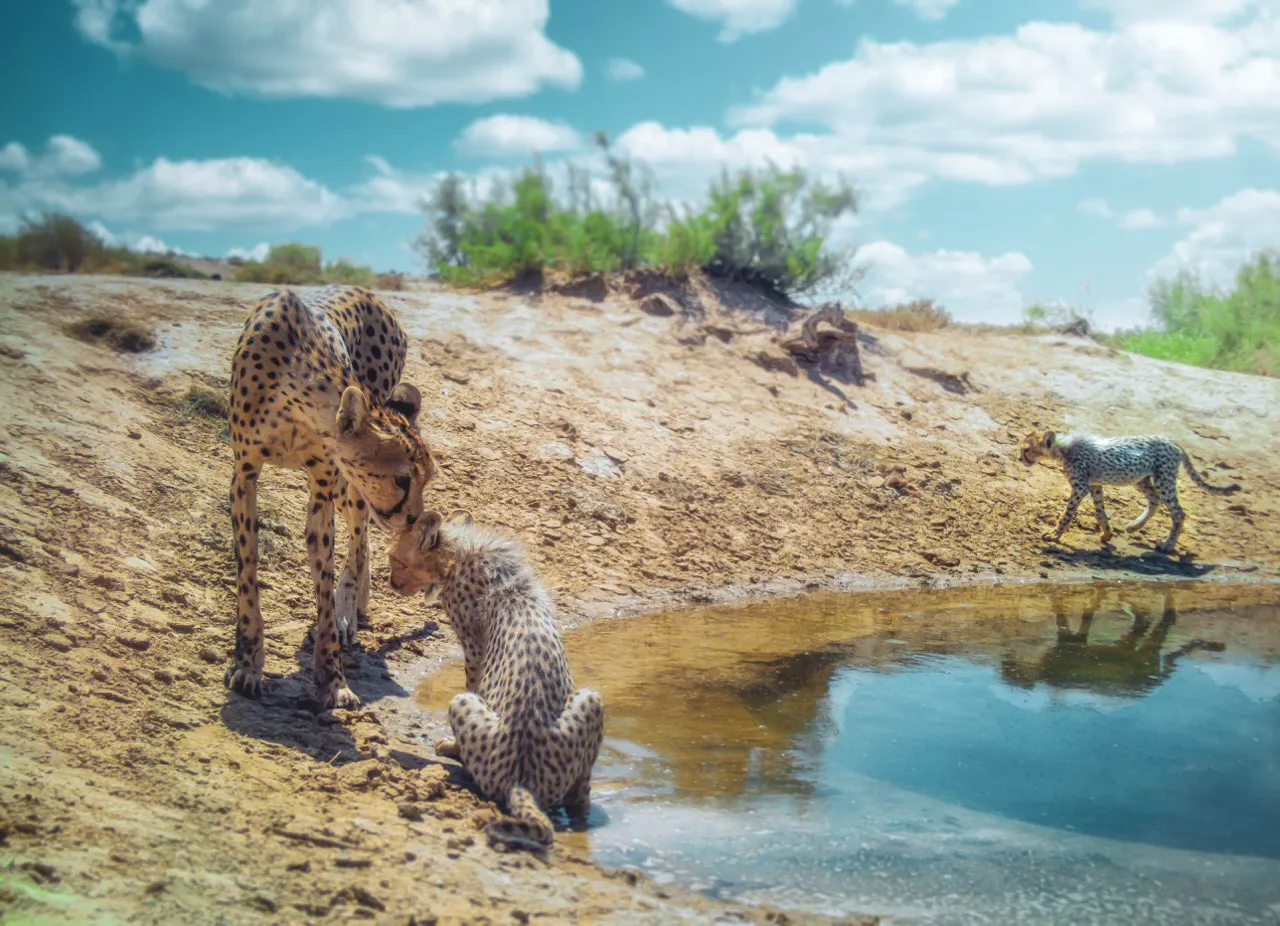
Image credit: Courtesy of the Iranian Cheetah Society, DoE, SPOTS
In this context, responsibility cannot rest solely at the national level. The international conservation community has a critical role in ensuring continuity through scientific collaboration, flexible funding mechanisms, technical assistance, and sustained global attention. Conservation cannot be isolated from broader geopolitical realities. Durable environmental protection is closely linked to stability, international cooperation, and long-term institutional support.
Preventing the extinction of the Asiatic cheetah will require coordinated action that transcends political instability. Without sustained national and international engagement, decades of conservation progress could be lost, and one of the world’s most iconic felines may disappear forever.
-
-
Atie Taktehrani, Mahsa Shah Hosseini, et al. Will they survive? Alarming circumstances of Asiatic cheetah (Acinonyx jubatus venaticus) in Iran’s drylands. BioRxiv. Doi: https://doi.org/10.1101/2025.10.27.684750.
M. Farhadinia, H. Akbari, M. Eslami, M. A. Adibi, A review of ecology and conservation status of Asiatic cheetah in Iran. CATnews Special Issue 10 Autumn 2016 (2016).
T. N. International, ‘Only 12 Asiatic cheetahs left in Iran’. (January 10, 2022).
United Nations Development Program, Available: https://www.ir.undp.org/content/iran/en/home/projects/Conservation-of-Asiatic-Cheetah-Project-Phase-II.html. (2019).
M. Farhadinia, F. Jafarzadeh, E. Sharbafi, E. Moqanaki, Conservation Education to Save the Endangered Persian Leopard in Iran(2011).
M. S. Farhadinia et al., A paradox of local abundance amidst regional rarity: the value of montane refugia for Persian leopard conservation. Sci Rep 9, 14622 (2019).
Global Tiger Recovery Program, Available: http://documents1.worldbank.org/curated/en/874191468331048098/pdf/732050WP00Box30110Final0Version0Eng.pdf. (2010).
The International Gorilla Conservation Programme (IGCP), Available: https://www.fauna-flora.org/approaches/partnership/international-gorilla-conservation-programme. (2019).
S. M. Durant et al., The global decline of cheetah Acinonyx jubatus and what it means for conservation. Proc Natl Acad Sci U S A 114, 528-533 (2017).
L. Khalatbari, H. Jowkar, G. Yusefi, J. Brito, S. Ostrowski, The current status of Asiatic cheetah in Iran. 66, 10-13 (2017).
J. Parchizadeh, S. T. Williams, Save Iran's cheetah from extinction. Nature 552, 31 (2017).
J. Parchizadeh et al., Roads threaten Asiatic cheetahs in Iran. Curr Biol 28, R1141-R1142 (2018).
L. T. B. H. Mohammad S.Farhadinia, Houman Jowkar, George B. Schaller, Stephane Ostrowski,, Asiatic Cheetahs in Iran: Decline, Current Status and Threats. Biodiversity of World: Conservation from Genes to Landscapes 10.1016/B978-0-12-804088-1.00005-8, 55-69 (2018).
D. W. Ronald R. Swaisgood, Fuwen Wei, Panda Downlisted but not Out of the Woods. Conservation Letters 11, 1-9 (Feb 2017).
N. R. Singh AP, Estimation of the Status of Asiatic Lion (Panthera leo persica) Population in Gir Lion Landscape, Gujarat, India. . The Indian Forester 144, 887-892 (2018).
K. Banerjee, Y. V. Jhala, K. S. Chauhan, C. V. Dave, Living with lions: the economics of coexistence in the Gir forests, India. PLoS One 8, e49457 (2013).
-
Explore similar content

Subscribe to receive monthly updates on climate solutions, environmental heroes, and the profound beauty and wonder of our shared planet Earth.
_female_CC-Charles%20Sharp-2014_resized.jpg?auto=compress%2Cformat&h=600&w=600)